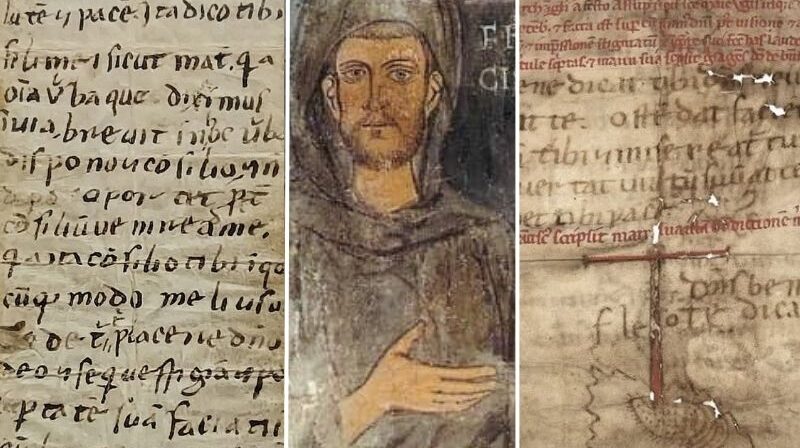
Between Spoleto and Assisi, two precious autographs are still preserved today, allowing us to draw closer to the most personal dimension of Francis’s life.
When we think of St. Francis of Assisi, what immediately comes to mind is the Basilica of Assisi, the Canticle of the Creatures, poverty, preaching and the great places of Franciscan spirituality in Umbria. There is, however, a more intimate dimension to his story, made up of personal relationships, friendships and words entrusted to writing. In this context, a particularly significant role is played by Brother Leo, one of the companions closest to Francis, who accompanied him through numerous important moments of his life.
Two documents of extraordinary value are linked to him: the Letter to Brother Leo, preserved in the Cathedral of Spoleto, and the Chartula, kept at the Basilica of St. Francis in Assisi.
These constitute the only certain autograph testimonies written directly by Francis’s hand, unlike other texts attributed to him, such as the Testament, which was instead dictated. These brief documents therefore offer particularly precious evidence of Francis’s handwriting and his knowledge of Latin, which was absolutely modest and essential, developed through his youthful education and familiarity with liturgical readings, rather than through any real academic training.
😯 THE LETTER TO BROTHER LEO
The Letter to Brother Leo (the Spoleto letter) is a small parchment (5.5 x 12.5 cm), now kept in the Cathedral of Spoleto. The document is particularly important because it allows us to know a very personal aspect of the relationship between Francis and his companion. Leo was going through a difficult moment and turned to Francis for advice. The saint’s response is not a simple instruction, but an invitation to look within himself and to follow what, according to his own conscience, would best allow him to please God and to live in poverty. The letter thus reveals a particular delicacy in the way Francis related to his friars: advising without imposing, leaving room for personal freedom and, at the same time, offering his own closeness. It is precisely this intimate dimension that makes the Spoleto parchment one of the most fascinating testimonies of Franciscanism in Umbria.
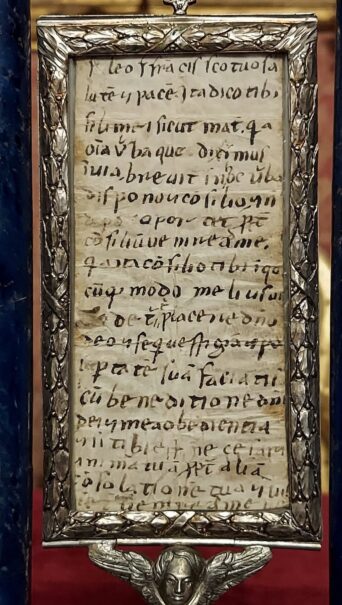
CRITICAL EDITION – LATIN TEXT:
F(rater) Leo, f(rater) Fra(n)cissco tuo sa-
lute(m) et pace(m). Ita dico tibi
fili mei, sicut mat(er): q(ui)a
o(mn)ia v(er)ba, que diximus
i(n) via, brevit(er) in hoc v(er)bo
dispono (et) co(n)silio, (et) si
dopo [tibi?] oportet p(ro)pt(er)
co(n)siliu(m) venire ad me
q(ui)a ita co(n)silio tibi: i(n) qo-
cu(m)q(ue) modo melius vi-
det(ur) t(ibi) placere D(omi)no Deo
(et) seq(ui) vestigia(m) (et) pa-
up(er)tate(m) sua(m) faciatis
cu(m) beneditione D(omi)ni
Dei (et) mea obedientia.
(Et) si tibi est necesar(ium)
anima(m) tua(m) p(ro)pt(er) alia(m)
co(n)solatione(m) tua (et) vis,
venire ad me, ve[ni]
TRANSLATION:
To Brother Leo, your brother Francis, health and peace. Thus I say to you, my son, as a mother would, that all the things we said briefly, along the way, I sum up, arrange and advise in this one word, and there is no need for you to come to me for advice. Therefore I advise you: in whatever way seems best to you to please the Lord God and to follow his footsteps and his poverty, do it, with the blessing of the Lord God and my obedience. But if it is necessary for you, for your soul, and for your further consolation and strength, to return to me, come.
Even better known is the Chartula of St. Francis (Chartula fratri Leonis), the small sheet with the Blessing to Brother Leo. Francis wrote it on Mount La Verna in September 1224, two years before his death. The ancient 10 x 14 cm parchment is kept in the Sacro Convento of Assisi, while a copy is displayed in the chapel of St. Nicholas, in the lower basilica of St. Francis. The back of the sheet contains the Praises of the Most High God (Laudes Dei altissimi). Tradition tells us that Leo was going through a moment of particular inner difficulty. Francis therefore entrusted him with a personal blessing, accompanying it with a prayer of praise to God. Leo kept this small parchment with him always, folded in half, as a personal memento and as a relic of his bond with the saint, adding over time some annotations in red ink.
The text of the blessing corresponds almost entirely to the “Blessing of Aaron” from the Book of Numbers (Num 6, 24-26).
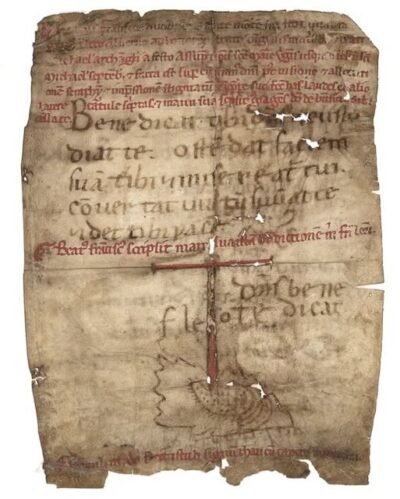
CRITICAL EDITION – LATIN TEXT:
Benedicat tibi D(omi)n(u)s (et) custo-
diat te. Oste(n)dat faciem
sua(m) tibi (et) misereat(ur) tui.
Co(n)vertat vultu(m) suu(m) ad te
(et) det tibi pace(m).
D(omi)n(u)s bene-
dicat
f(rater) Leo, te.
TRANSLATION:
May the Lord bless you and keep you. May he show you his face and have mercy on you.
May he turn his countenance toward you and give you peace.
May the Lord bless you, Brother Leo.
🙂 THE TAU AND THE BLESSING TO BROTHER LEO
On the Chartula the Tau also appears, one of the most important symbols of Franciscan spirituality and particularly dear to Francis. The document thus takes on an even more particular value: it is not merely a religious text, but a true personal testimony of the relationship between Francis and Leo. Its writing, the blessing and the Praises of the Most High God tell of a moment of great spiritual intensity. For those visiting the Franciscan sites of Umbria, being able to learn the story of this small parchment means drawing closer to the figure of Francis through a lesser-known and more intimate aspect of his life as well.
😯 BROTHER LEO’S ANNOTATIONS
- Latin text: «Beatus Franciscus duobus annis ante mortem suam fecit quadragesimam in loco Alvernae ad honorem beatae Virginis Mariae et beati Michaelis archangeli a festo Assumptionis sanctae Mariae usque ad festum sancti Michaelis septembris; et facta est super eum manus Domini per visionem et allocutionem seraphim et impressionem stigmatum Christi in corpore suo. Fecit has laudes ex alio latere cartulae scriptas et manu sua scripsit, gratias agens Domino de beneficio sibi collato.»
- Translation: «Blessed Francis, two years before his death, kept a Lent in the place of La Verna in honor of the blessed Virgin Mary and the blessed Archangel Michael, from the feast of the Assumption of St. Mary until the feast of St. Michael in September; and the hand of the Lord came upon him through the vision and speech of a seraph and the impression of the stigmata of Christ upon his body. He composed these praises written on the other side of the parchment and wrote them with his own hand, giving thanks to the Lord for the favor bestowed upon him.»
- Latin text: Beatus Franciscus scripsit manu sua istam benedictionem mihi fratri Leoni.
- Translation: Blessed Francis wrote with his own hand this blessing for me, Brother Leo.»
- Latin text: Simili modo fecit hoc signum thau cum capite manu sua.
- Translation: In like manner he made this sign of the Tau with the head with his own hand.» (Note: the “head” refers to the drawing of a human head or a rock on which the cross rests).
Thanks to Leo’s red ink (a cinnabar-based pigment), historians have absolute certainty that the Chartula is one of the very few original autographs of St. Francis to have survived intact to the present day.