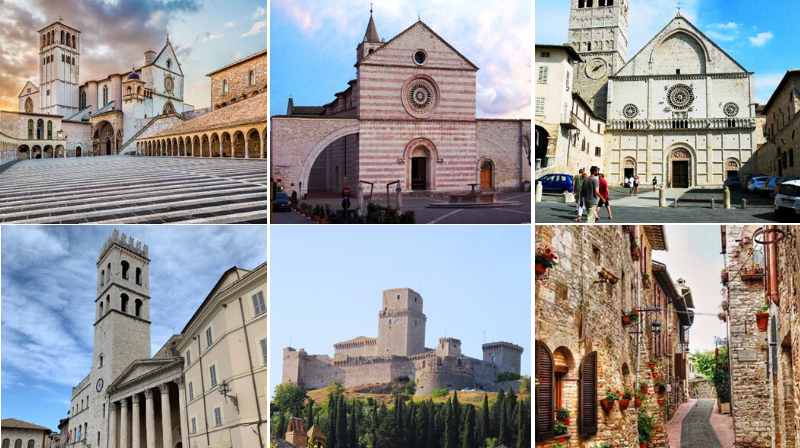
A list of the 10 places you absolutely must see in Assisi, the city of Saint Francis and a UNESCO World Heritage Site.
Assisi is an unforgettable city. This is not just a figure of speech; it really is. There is something magical and unique about it that remains with you as a lasting memory after you have visited. Among the thousands of tourists who come to visit the places associated with Francis, most do not have the chance to stay “in town” for more than a few hours, especially those travelling as part of an organized group; and that is a great pity, because in addition to the classic itinerary that starts at the Basilica of Saint Clare and, passing through the historic centre, reaches the Basilica of Saint Francis, there are other beautiful places, all within a few dozen metres of one another, that are absolutely worth visiting; it is no coincidence that the city has been included on the UNESCO World Heritage List. There is Franciscan Assisi, medieval Assisi, mystical Assisi, but also secular Assisi, Roman Assisi and romantic Assisi. We have taken the liberty of putting together a ranking of the 10 places you absolutely must see, with the aim of convincing you to spend two or more days in this little paradise:
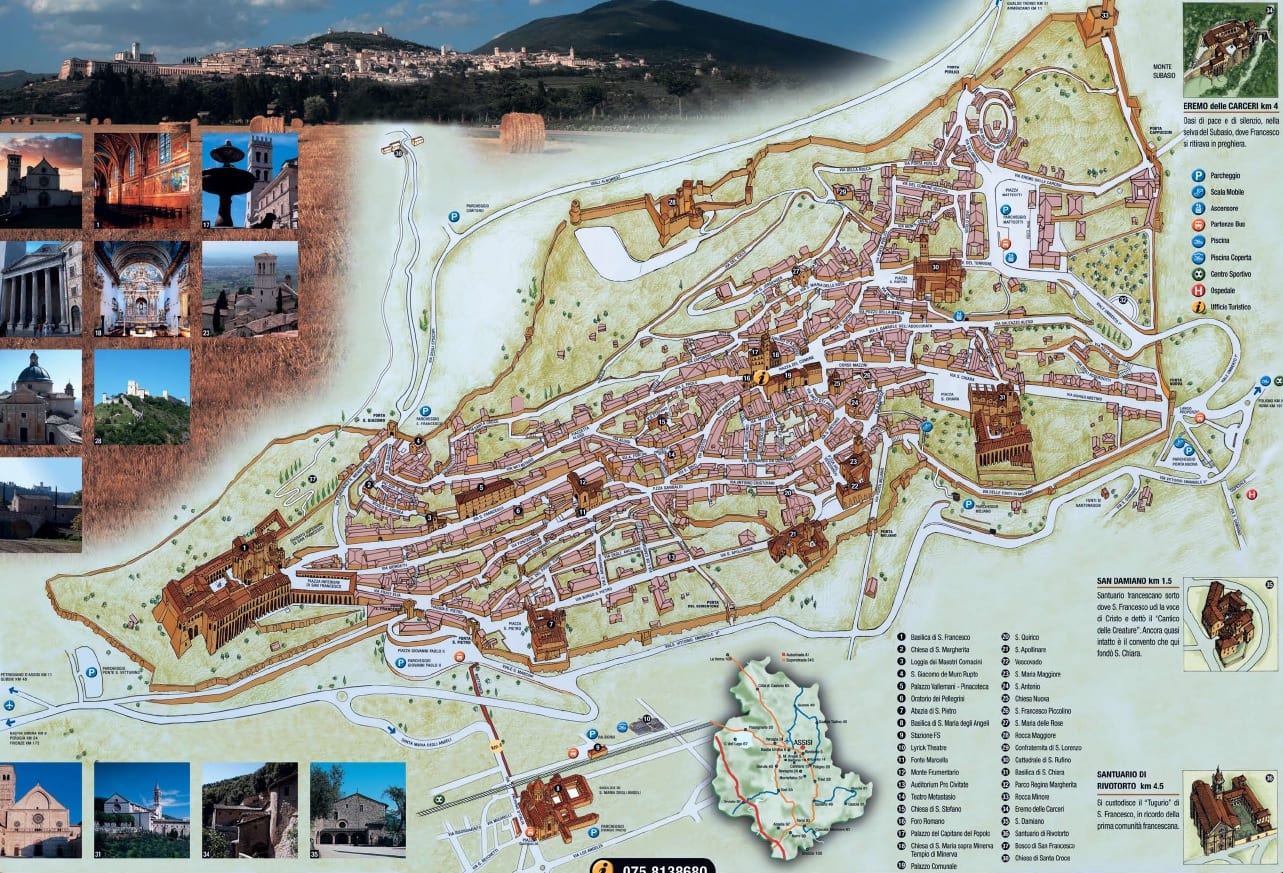
Map of Assisi (click to download)
1) THE BASILICA OF SAINT FRANCIS
Imposing and magnificent, with its two churches, the Upper Basilica, bright and soaring, and the Lower Basilica, darker and more austere, as well as the crypt where the Tomb of the Saint is preserved. With its collection of masterpieces (frescoes by Cimabue, Giotto and his school, Pietro Lorenzetti, Simone Martini, Cesare Sermei, etc.) and the spread of the artistic and spiritual message of the Franciscan Order, it has become a fundamental reference point in the history of art in Europe and throughout the world. Also worth visiting are the chapter house (Chapel of the Relics of Saint Francis), the Sisto IV Cloister, the Treasury Museum and the rest of the Sacred Convent complex, with its library and archive.
2) THE BASILICA OF SAINT CLARE
Dedicated to the young nun, Francis’s first female follower and founder of the Order of Poor Clares. The building, in Italian Gothic style, is instantly recognizable for its three large external buttresses in the form of broad flying arches and is built with the characteristic pink stone quarried from Mount Subasio. It contains precious frescoes dating from the period between the 12th and 14th centuries. In the first chapel on the right along the basilica’s single nave, you can admire the Crucifix, painted on a wooden panel, which, according to tradition, spoke to Francis in San Damiano, inviting him to “rebuild the Church”. The crypt houses the earthly remains of the Saint, as well as some particularly well-preserved relics of Clare and Francis. From the square in front of the church, you can enjoy a splendid panorama which, on clear days, stretches across the Umbrian Valley from Montefalco to Perugia.
3) THE ROCCA MAGGIORE
Medieval fortress overlooking Assisi from above, it was the seat of the city’s political power and was renovated several times. There are records of it as early as 1173, when Assisi was occupied by the men of Frederick Barbarossa; it was subsequently abandoned until 1367, when Cardinal Egidio Albornoz decided to rebuild it on the foundations of the ancient German fortification. You have to walk up a small hill to reach it, but once at the top, the panorama over the entire Umbrian Valley more than repays the effort. Inside, there are rooms containing reconstructions of medieval life. Admission is subject to a fee.
4) THE CENTRAL SQUARE AND THE TEMPLE OF MINERVA
The place where social and political life took place for centuries. The square is overlooked by the city’s most important buildings: the Palazzo del Capitano del Popolo, Palazzo dei Priori, the Torre del Popolo and the Temple of Minerva with its six unmistakable Corinthian columns, an ancient Roman building dating from the Republican era, now the Church of Santa Maria sopra Minerva. The square is closed off at the upper end by a monumental 18th-century fountain, the Fountain of the Two Lions.
5) THE ROMAN FORUM
Underground Assisi from the Roman period, a lesser-known testimony to ancient Asisium, with the remains of the town’s original forum. Admission is subject to a fee; for more information CLICK HERE. Assisi is also home to two excellent examples of Roman Domus: the Domus of Propertius and the Domus of the “Lararium” (open to visitors by reservation only); they are richly decorated, with original marble floors and precious frescoes that testify to the prosperity of their patrons and the high level of craftsmanship.
6) THE CATHEDRAL OF SAN RUFINO AND THE DIOCESAN MUSEUM
The Cathedral of Assisi, dedicated to Saint Rufinus, the city’s first bishop, is a testimony of great architectural and artistic value. The façade, in particular, is one of the most significant and beautiful examples of Romanesque art from the Umbrian school, with its rose windows and elaborate decorations. The diocesan museum (admission is subject to a fee) is also worth a visit; it includes the crypt containing the remains of the Saint, who preached the Gospel in Assisi during the first half of the 3rd century.
7) THE CHURCH OF THE NEW CHURCH AND THE FONDACO OF FRANCIS
An elegant Greek-cross building dedicated to the conversion of the Poverello of Assisi: in fact, it contains the space beneath the staircase where Pietro di Bernardone is said to have locked up his son after Francis fled to Foligno to sell cloth and use the proceeds to repair the church of San Damiano. It is also possible to visit the fondaco, where the young Francis worked with his father in the cloth trade.
8) THE ORATORY OF THE PILGRIMS
The small chapel dedicated to Saint Anthony the Abbot and Saint James of Compostela. It houses magnificent paintings and frescoes by Matteo da Gualdo, Pierantonio da Foligno and Andrea d’Assisi, a pupil of Perugino. If you are lucky enough to find it open, it is definitely worth a visit.
9) THE MUNICIPAL ART GALLERY
For art lovers and for those who do not want to limit their visit to Assisi to the city’s religious heritage. The most important piece in the collection is a Maestà attributed to Giotto, but there are also paintings by Puccio Capanna, Ottaviano Nelli, Nicolò di Liberatore and Pietro Perugino. Admission is subject to a fee.
10) THE STREETS AND ALLEYS OF ASSISI
If you do not have the opportunity to visit all these places, spend some of your time simply strolling around the city. Among the enchanting little streets, you will discover many small wonders around every corner.
Obviously, the list of things to see does not end here; you only need to step outside the walls of Assisi to find many other splendid and remarkable places connected with Saint Francis and Franciscanism; DISCOVER THE 10 THINGS TO SEE AROUND ASSISI BY CLICKING HERE!
😯 USEFUL INFORMATION
Once in Assisi, it is possible to purchase a combined ticket that allows you to visit the Rocca Maggiore, the Roman Forum and the Municipal Art Gallery (which together require at least one full day to visit).
🙂 An idea for the December 8, 2026 Immaculate Conception long weekend?
