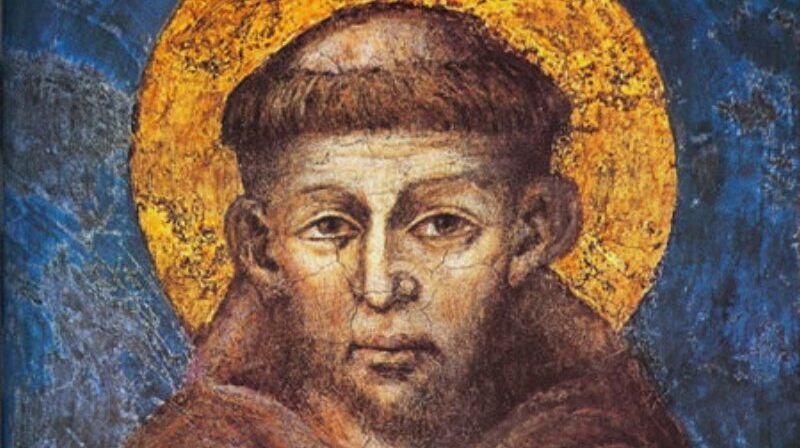
In search of the true face of Saint Francis, between artistic representations, history and legend.
Saint Francis, in addition to being the patron saint of Italy, is undoubtedly the most beloved saint among Italians. Over the years, there has been great interest in attempting to reconstruct his true face. The representations dedicated to him, however, portray very different images, offering multiple interpretations of the appearance of the Poor Man of Assisi. Numerous ancient paintings preserving his likeness are kept in Umbria, although the earliest iconographic evidence does not come from this region. The oldest known representation is in fact found in the church of Santa Maria Maggiore in Monte Sant’Angelo, in the province of Foggia: it is thought to have been made following an alleged visit by the Saint to the Shrine of the Archangel in 1216, an episode attested by scarce or uncertain sources and intertwined with legendary tradition. In this depiction, Saint Francis appears without the stigmata, while a halo is present, an element that is believed to have been added at a later date.

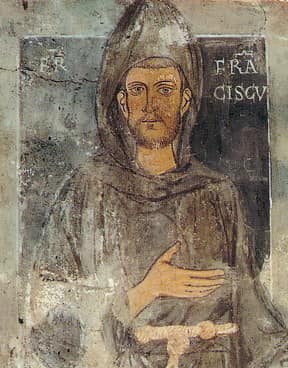
Next is one of the most famous depictions of Saint Francis, preserved in the Benedictine monastery of the Sacro Speco of Subiaco (Rome), inside the Chapel of Saint Gregory. According to tradition, the portrait was painted on the occasion of Francis’s visit to the monastery in 1223, when he accompanied Cardinal Ugolino of Ostia, the future Pope Gregory IX. During his stay, the cardinal consecrated a chapel and, according to this reconstruction, an anonymous monk took the opportunity to portray the saint from life, depicting him still without the stigmata and halo. Francis’s face bears a striking resemblance to that of the fresco at Monte Sant’Angelo, leading some scholars to believe that both images may preserve authentic features of his physiognomy. In his hand, the saint holds a scroll bearing the inscription PAX HVIC DOMVI (“Peace to this house”), while on either side of his head appears the inscription FR(ater) FRA(n)CISCV(s). One striking detail is the slight asymmetry of the eyes, one of which appears slightly larger than the other. This detail has sometimes been interpreted as a possible reflection of the serious eye operation Francis is said to have undergone at Fonte Colombo, near Rieti, before reaching Subiaco. According to tradition, the procedure was performed to treat a probable eye infection contracted during his stay in the Holy Land.
Also interesting is a panel painting (c. 1235), attributed to Bonaventura Berlinghieri and housed in the church of San Francesco in Pescia, in the province of Pistoia. The panel, Saint Francis and Scenes from His Life, is the earliest surviving work featuring the iconography of Franciscan stories: it depicts the Saint of Assisi standing centrally, very tall, hooded and dressed in a habit tied with a cord; in his left hand he probably holds the Gospel, while with his right hand he blesses and displays the stigmata. The six scenes in which Saint Francis is the protagonist, represented three on each side, include two episodes from his lifetime (Preaching to the Birds, Stigmata) and posthumous miracles.
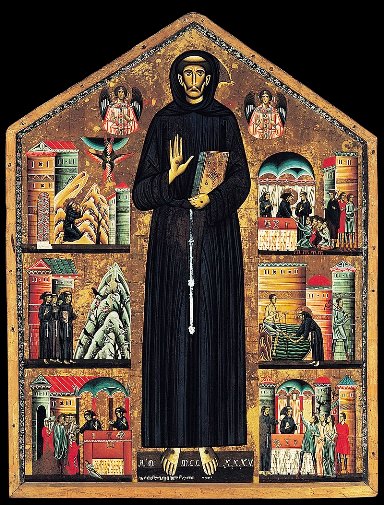
A fourth portrait (c. 1245–1250) is found in another panel, Saint Francis and Twenty Scenes from His Life, by Coppo di Marcovaldo (or Master of the Bardi Saint Francis), preserved in the Basilica of Santa Croce in Florence (so-called Bardi panel). Saint Francis is depicted standing, blessing, with a book in his left hand. The inner decorative band contains small busts of Franciscan friars, which may allude to the Santa Croce community of the time. The twenty scenes surrounding Francis – forming the most complete narrative of the saint’s life before the Assisi cycle – are drawn from the First Life by Thomas of Celano (1228–1229) and are to be read counterclockwise, starting from the upper left. The scroll at the top reads HV[N]C EXA-/VDITE P(ER) / HIBENT[EM] / DOGMAT-/A VITE, meaning “obey this man who bears the doctrines of life.” Among the painted scenes is a very rare depiction of Francis Healing Lepers (lower down, detail), of which there is no trace in the abundant iconography of the Poor Man of Assisi, including the great fresco cycles in Assisi, Florence and Padua attributed to Giotto.


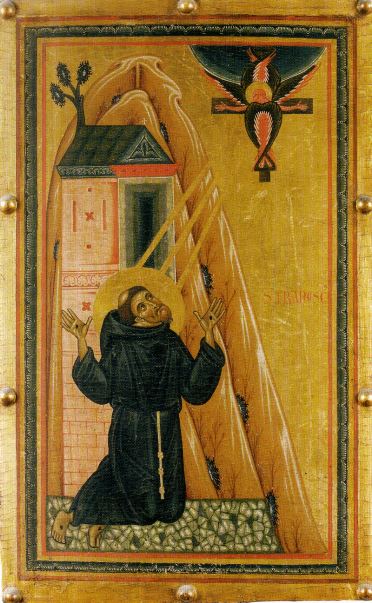
A fifth portrait (c. 1250) is a panel painting, Stigmata of Saint Francis, attributed to the Master of the Uffizi Crucifix No. 434 or to the Master of the Bardi Saint Francis, preserved in the Uffizi Gallery in Florence. Francis appears kneeling in the foreground with his hands and feet clearly visible, while receiving the stigmata from a crucifix appearing in the sky, in the upper right, in which a mystical Jesus on the Cross is covered by angelic wings. A red inscription on the right specifies the name of Saint Francis.
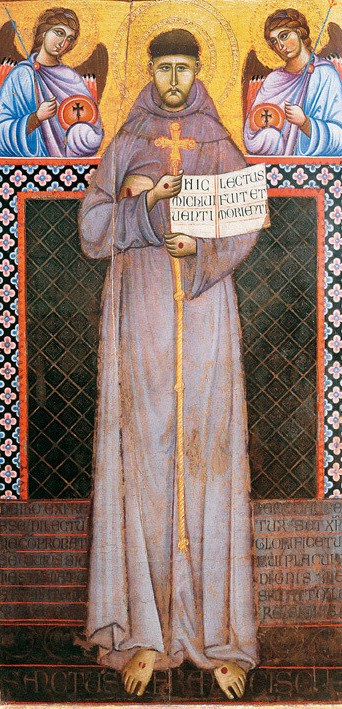
A sixth portrait (second half of the 13th century) is preserved in the museum of the Porziuncola of Santa Maria degli Angeli (PG) and depicts Francis between Two Angels. The Poor Man holds the Crucifix in his right hand and the open book in his left. The painting, attributed to the Master of Saint Francis, is on a wooden board traditionally believed to be Francis’s deathbed, as also specified by the message in the book: HIC / MICHI VI-/VENTI / LECTVS / FVIT ET / MORIENTI, meaning “this was my bed, while I lived and when I died”.
In Abruzzo, in the province of L’Aquila, as at Monte Sant’Angelo and Subiaco, there are three other portraits of Francis without the stigmata, although they date from a later period. The first is located on the counter-façade of the splendid Oratory of San Pellegrino in Bominaco (AQ), often described as the “Sistine Chapel of Abruzzo”. The traditional dating of the paintings, set at 1263, demonstrates that images of the Saint without the marks of the stigmata were still being produced during the second half of the 13th century.

A second Saint Francis without the stigmata is the one painted in the church of San Pietro in Valle at Caporciano (AQ), not far from Bominaco.

Finally, a third depiction of the Saint, without the marks of Christ and pointing with his right hand toward a cherub, is located on the rear wall of the chapel in the transept of the church of San Pelino in Corfinio (AQ) and can be dated approximately to the third quarter of the 13th century.

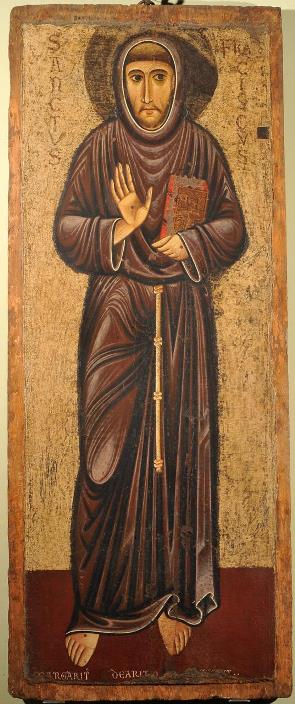
A tenth portrait (c. 1260–1275), attributed to Margarito Di Magnano, known as Margaritone d’Arezzo, is a panel painting housed in the Arezzo Municipal Art Gallery following the suppression of the Franciscan convent of Sargiano (AR). It is the most famous among the panel paintings of the Saint bearing Margarito’s signature: autograph replicas probably derive from this work, including panels preserved in the National Picture Gallery of Siena, the Vatican Pinacoteca, Castiglion Fiorentino, Montepulciano, Zurich and, finally, the Roman church of S. Francesco a Ripa. At the bottom, beneath Francis’s feet, appears the inscription MARGARIT(VS) DE ARITIO [ME FECIT].
Another little-known representation is found in the church of San Tossano of Agolla in Sefro, in the province of Macerata, recently restored. The fresco dates to the end of the 13th century (c. 1280–1300), with a possible extension into the very early years of the 14th century based on its stylistic characteristics. The work belongs to an early phase of medieval painting in the Marche region, still linked to the Byzantine tradition but open to new figurative trends from central Italy. The figure without stigmata, formerly identified as Saint Anthony of Padua, was subsequently recognized as Saint Francis of Assisi thanks to more recent art-historical studies. This identification gives the fresco particular significance, as it is considered the oldest surviving depiction of the saint in the Marche region.

The twelfth portrait I propose is the most famous of all: it is located in the right transept of the Lower Basilica of Saint Francis of Assisi and is the work of Cimabue. The depiction of the Poor Man in the recently restored fresco of Madonna Enthroned with the Child, Angels and Saint Francis, also known as the Maestà of Assisi, dates to between 1285 and 1290.
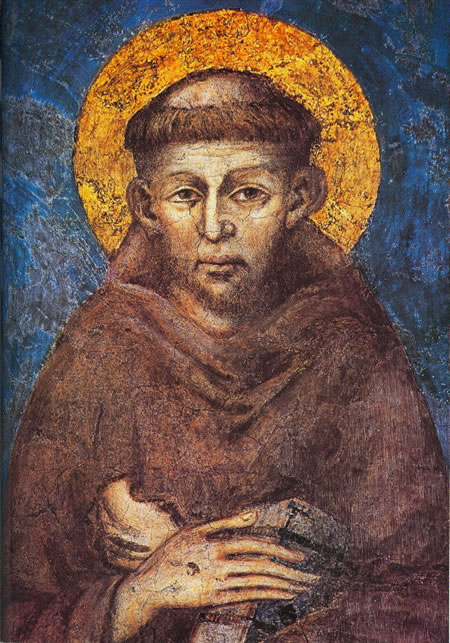
Another painting with the same facial features, also attributed to Cimabue, but this time on panel, is housed at the Porziuncola Museum in Santa Maria degli Angeli in Assisi.

Although the Tuscan painter, born around 1240, could never have personally known the Saint of Assisi (who died in 1226), scholars have repeatedly argued that these two portraits were the first attempts to adapt the Saint’s iconography to the description found in Franciscan sources:
«Of moderate stature, rather tending toward smallness, head of medium size and round, face somewhat long and elongated, forehead flat and small, eyes of medium size, black and serene, dark hair, straight eyebrows, nose proportionate, slender and straight, ears upright but small, temples flat, speech gentle, fiery and penetrating, voice strong, sweet, clear and sonorous, teeth close together, even and white, lips moderate and thin, black beard, not fully covered with hair, slender neck, straight shoulders, short arms, thin hands, long fingers, elongated nails, slender legs, small feet, delicate skin, very little flesh, rough garment, very short sleep, most generous hands» – Thomas of Celano, First Life, ch. 29.
Translation: “Not tall in stature, rather small, with a round and proportionate head, a somewhat oval and elongated face, a flat and small forehead, medium-sized, black and serene eyes, dark hair, straight eyebrows, a proportionate, slender and straight nose, upright but small ears, flat temples, gentle, fiery and penetrating speech, a strong, sweet, clear and sonorous voice, well-aligned, regular and white teeth, thin lips, a black and sparse beard, a slender neck, straight shoulders, weak arms, thin hands, long fingers, elongated nails, slender legs, delicate skin, very thin, a coarse garment, very little sleep, and the most generous hand”.
There is actually another portrait, considered among the most faithful to Francis’s real physiognomy. It is preserved in the Sanctuary of Greccio (Rieti), a place that Saint Francis probably visited several times during his travels in Italy. According to tradition, the work was commissioned by Jacopa dei Settesoli one year before the Saint’s death: Jacopa had met Francis in Assisi in 1210 and subsequently helped him in Rome, facilitating his hospitality and his meeting with Pope Innocent III. The painting, however, is executed on canvas glued to a panel and therefore cannot be considered the original; it may be a 14th-century copy, an hypothesis also supported by a style that appears later. The Saint is depicted as small in stature and suffering, wiping his left eye with a handkerchief: the final years of his life were in fact marked by a serious eye condition, which forced him to undergo a painful operation. We leave this work to your judgment.
